
2.1Value Creation Model
Vitens creates societal value by providing reliable and sustainable drinking water with minimal impact on people and nature. This is for the benefit of current and future generations.
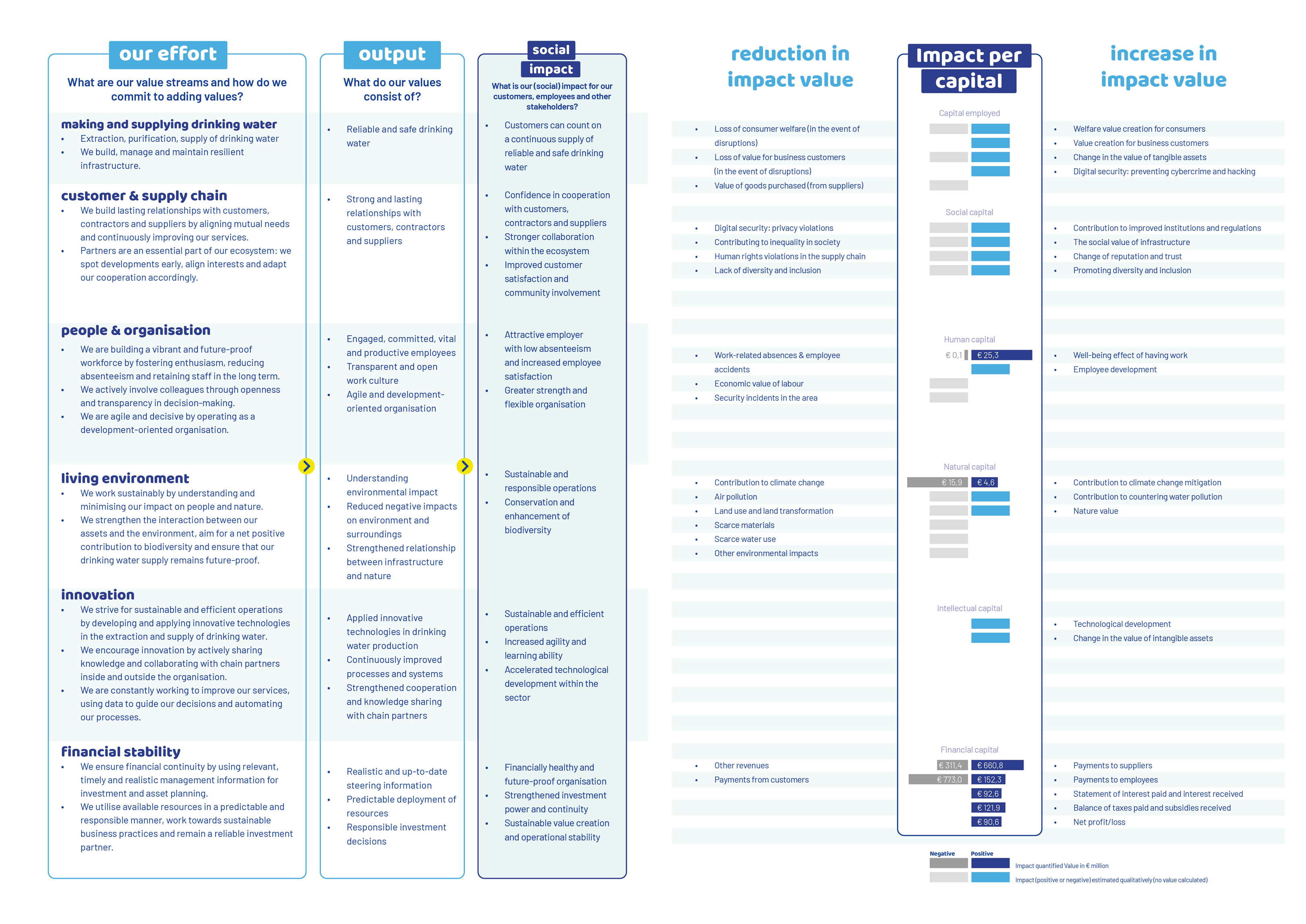
The value creation model is structured around the six value streams (see sections 2.1.1 to 2.1.6 for further explanation), which form the core of our new strategy and social responsibility. We use this model alongside the presentation of impact in our sustainability statement based on the double materiality principle, as this model demonstrates how Vitens translates its resources and activities into concrete performance and impact for customers, employees, partners, and the local community. Although some activities may have a negative impact, our aim is to increase societal value over the long term. We do this by gradually reducing negative effects and strengthening positive ones, so that we create greater net value for society.
In our value creation model, we show the following:
- Which value streams we deploy and how we do so (our contribution);
- What those values consist of (output);
- What we aim to achieve for our customers, employees, partners, and the living environment (impact);
- Value of impact: showing the extent to which Vitens reduces negative effects (a reduction in impact value) and increases positive effects (an increase in impact value). Impact is largely described qualitatively and, where possible, expressed in euros to make social value transparent and comparable.
The six value streams are linked to the six capitals as described in the Impact Measurement Handbook for Infrastructure Companies (Dutch only, version 2024). The handbook contains a core concept and guidelines that have been jointly developed and used by the participating infrastructure companies. Through this connection, we show how our value streams generate societal value and measure the resulting impacts, both qualitatively and quantitatively. As a result, we are more focused on long-term value creation. More information on how Vitens does this can be found in the 'Accountability impact measurement' (Dutch only).
2.1.1Making and supplying drinking water
Producing and supplying drinking water is essential for people's health and well-being. After abstraction, purification takes place at 93 production sites, where techniques such as filtration, aeration and post‑filtration are used to remove substances such as lime and iron and, where possible, to recover them for reuse. Water is reliably supplied to six million customers via a network of pipes stretching some 48,000 kilometres. This security of supply requires ongoing investment in robust infrastructure and sustainable solutions. For example, on 1 May, the outdated production site in Doorn was closed and the modernised site in Cothen came into operation, thereby making the region's drinking water supply future-proof.
In 2025, Vitens was faced with a number of boil-water advisories, including one major one. In parts of Utrecht and surrounding areas, some 125,000 households had to temporarily boil their drinking water for three minutes before use, due to bacterial contamination caused by damage to a reservoir roof. Vitens responded with flushing operations, intensive monitoring, and transparent communication to quickly restore safety. By continuously investing in the maintenance, replacement and protection of production plants and the pipeline network, we ensure the continuity of drinking water supply.
2.1.2Customer and supply chain
Vitens regards strengthening relationships with customers and chain partners as an important value stream that contributes to reliability and societal value. We focus on customer needs through customer‑journey research, complaint analysis and the improvement of our contact processes. These insights help us to continuously optimise services and increase customer trust. Besides direct customer interaction, collaboration in the chain plays a major role. We actively work with suppliers, contractors and other partners to align processes. This increases efficiency and ensures that customer value remains central across every link in the chain.
External stakeholders such as provinces, municipalities, and water authorities are also closely involved in joint challenges, including water conservation and sustainable area development. This collaboration allows Vitens to respond to societal challenges. In 2025, we worked on improving customer interaction, acting on recommendations from previous analyses, and strengthening collaboration in the event of incidents, such as boiling water advisories and a major leak. The ultimate goal is to continue to provide a reliable service and create sustainable value for customers and partners, both now and in the future.
2.1.3People and Organisation
Vitens aims to increase its societal value by being an attractive employer. Within the People & Organisation value stream, we work on sustainable value for employees and the organisation. In 2025, the focus was on redesigning the organisation to bring more logic and order to its structure and governance. This leads to clearer decision-making and creates more room for professional expertise.
To equip managers effectively, a leadership programme was launched in collaboration with an organisational consultancy. We are also building a vital and future-proof workforce by fostering engagement, reducing absenteeism, and ensuring long-term employee retention. Specific initiatives include the further development of the job classification system, the strategic workforce planning toolbox and the job evaluation toolbox, which contribute to transparency and career development.
We foster a culture of learning and actively involve staff in improvement initiatives. The ongoing development of performance and development reviews also plays an important role in this. By digitalising People & Organisation processes and, among other things, applying AI, we work in a more agile and effective way, freeing up more time for organisational development.
Vitens continues to invest in leadership, vitality, and an inspiring working environment in which talent and professionalism are central. This is how we create sustainable value, now and in the future.
2.1.4Living environment
Vitens aims to create societal value by minimising the negative impact of water abstraction on the living environment. In 2025, we continued our efforts with measures aimed at reducing the impacts on nature and agriculture. This helps protect groundwater sources, and in several abstraction areas we are taking steps to counteract drought. In addition, water abstraction areas have been designed with nature-friendly banks and flower-rich grasslands, making these areas not only functional for drinking‑water production but also contributors to ecosystem restoration and biodiversity enhancement. This approach aligns with our ambition to create a balanced water system that also benefits agriculture and recreation.
In addition, within the Agriculture and Soil Programme, Vitens works with governments, farmers, and civil-society organisations on an integrated approach to water management and nature development. Examples include projects, where we work with farming organisations to reduce nitrogen and promote biodiversity. Vitens also collaborates in water abstraction areas on the Veluwe with the Epe–Heerde Sheep Flock, using sheep grazing to prevent heathland from becoming overgrown. This contributes to healthy soil and sustainable drinking water abstraction.
We are constantly making our business more sustainable by reusing residual streams and being more energy efficient. An example of this is the use of calcite that is produced during the softening of water. In Espelo, we now use calcite instead of filter sand, and this circular application is currently being rolled out at two other locations as well. Calcite is used as a starter material onto which lime adheres and grows during the softening of drinking water. The aim is to replace filter sand with calcite across Vitens as a whole. This reduces our need for primary raw materials, making us less dependent on suppliers while enabling the reuse of our own residual streams. In a next phase, we want to use calcite with grafted lime as a substitute for marble.
2.1.5Innovation
Innovation is an important part of Vitens' strategy. It is clearly set out in our plans. New technologies and digitalisation are needed to make our infrastructure resilient. Innovation is integral to smart working and responsible resource management. This allows Vitens to prepare for challenges such as labour shortages, climate change and unexpected situations. To achieve this, we share knowledge and continually work on new technology.
In 2025, we made progress in digitalisation and in how we work with data. AI policies have been established, and Copilot agents are supporting processes. We have also started improving asset data. This means ensuring reliable and comprehensive information about our assets (such as pipelines, pumps and installations). This data is crucial for effective management and maintenance. This year, we made progress in establishing a new uniform standard for process automation, ensuring consistent, modern, and secure control of our installations. We also started applying process mining. Applying process mining means analysing digital traces in our systems to gain insight into how processes actually work. This allows us to identify and improve bottlenecks and inefficiencies, with the aim of working smarter and more efficiently. Vitens invests in solutions that improve our work and contribute to long-term sustainability.
By focusing on innovation, Vitens ensures more than just technological progress. It makes our drinking water supply more reliable, increases the flexibility of systems and helps with societal goals such as sustainability and efficiency. So innovation is not just another topic, but a key pillar.
2.1.6Financial continuity
Vitens safeguards its financial continuity by seeking a healthy balance between investments, risk management, and a sound financing structure. This enables us not only to meet the growing investment requirements, but also to create sustainable value for our customers, employees, and other stakeholders. Our core activities (the abstraction, treatment, and distribution of drinking water) form the foundation of our societal impact. By investing in a resilient and robust infrastructure and in innovative technologies, we ensure the reliable and safe supply of drinking water, both now and in the future. A healthy financial position is thus a prerequisite for creating value for our stakeholders.
Financial continuity is safeguarded through the use of relevant, timely and realistic management information relating to investments, cash flows and capital control. We use our available resources in a predictable and responsible way, allowing us to remain a solid investment partner. This enables us not only to invest in our own operations, but also in creating societal value, such as enhancing the living environment, improving (digital) safety, and safeguarding the quality of drinking water.
Solvency (equity to debt ratio) is an important measure for assessing financial health. The higher the solvency, the healthier Vitens' financial position. To realise the intended investments, we need to strengthen our equity. An addition from net income contributes to this. We will therefore not distribute any dividend to shareholders in 2025, allowing us to add the full result to our equity. We aim for a solvency ratio of 35%, but this is currently not achievable (solvency 2025: 30.5%). This is due on the one hand to the scale of the investment challenge, and on the other to the fact that our maximum achievable operating result (EBIT) is capped by statutory regulation.