
3.1General Information
3.1.1Basis for preparing information
General basis for preparing the sustainability statement
The Vitens sustainability statement for 2025 has been prepared in accordance with Vitens’ reporting criteria, namely the ESRS standards published by the European Commission on 31 July 2023, with the exception of the disclosure requirements relating to the EU Taxonomy for sustainable activities. We have voluntarily chosen to prepare our annual report in accordance with the above criteria. At the time of publication of our Annual Report 2025, the CSRD has not yet been officially incorporated into Dutch law. The sustainability statement has been prepared on an individual basis (no consolidation). The scope is thus the same as the scope of the financial statements.
The scope of the sustainability statement covers the supply of drinking water to all households and businesses within Vitens' entire supply area. Policies, actions, benchmarks and objectives relate to its own activities. Deviations from this are explicitly mentioned in the notes.
Vitens did not use the option to omit specific information elements that constitute intellectual property, know-how or the results of innovation. Consequently, no specific items of information have been omitted.
We report solely on the financial resources allocated to actions where such expenditure is deemed material. Where this is not the case, no amounts are reported. Actions relate to the reporting year; any deviations from this are explicitly stated. Non material actions are funded from the operating budget of the year in which they occur.
In addition to our own activities, the Sustainability Statement includes information on our upstream and downstream value chain. We highlight the following components in relation to the value chain:
- The outcome of the double materiality assessment shows the related material impacts, risks, and opportunities, and which part of the value chain they relate to;
- The policy, actions and objectives are set out as established within Vitens.
Where applicable, the phasing-in provisions made available under the ESRS guidelines have been applied. For an overview of the phasing-in options applied, please refer to the reference table included in section 3.5 of this Sustainability Statement.
Reporting on specific circumstances
Vitens has prepared the sustainability statement in accordance with the ESRS, with the exception of the disclosure requirements relating to the EU Taxonomy for sustainable activities, published by the European Commission on 31 July 2023. We recognise that a better understanding of the requirements may emerge as additional implementation guidelines or questions and answers are made available by the European Financial Reporting Advisory Group (EFRAG) and/or as the market develops. We also realise that the information available to assess certain industry benchmarks is limited and may only become available as the number of reporting organisations increases. We therefore strive to continuously improve the processes around sustainability reporting. The sustainability statement for the 2025 financial year is the first to be prepared on the basis of the ESRS standards, with the exception of the EU Taxonomy. The sustainability information for the 2024 financial year and earlier years was based on the Global Reporting Initiative (GRI). As a result, the content of the Sustainability Statement for the 2025 financial year includes an additional set of topics arising from the double materiality assessment.
No changes have been made to the existing calculations for the topics included in the 2024 sustainability statement, other than the additions relating to Scope 3 emissions.
Time horizons
For our reporting, we use three time periods (‘time horizons’) as prescribed in the ESRS:
- Short-term (KT): next calendar year
- Medium-term (MT): one to five years
- Long-term (LT): longer than five years
Value chain estimates
We have developed value chain estimates for the relevant metrics using indirect sources. This applies in particular to the calculation of Scope 3 emissions in our value chain, as prescribed in ESRS E1 Climate Change. Relevant information on this is provided under the respective metrics.
Sources of estimation uncertainties and uncertain outcomes
When preparing the sustainability statement, we make a number of assumptions and approximations and estimate certain figures. Some of these estimates are less precise. This applies in particular to:
- Greenhouse gas emissions metric. To determine our Scope 1 emissions, we use measurement data based on a limited number of measurement points. In our calculations, we therefore apply assumptions, extrapolations and alternative data sources. For Scope 3, we have used the available activity data. A significant share of the emissions has been calculated using the spend-based method, in which expenditures are linked to generic emission factors. Due to limited insight into the composition of purchased products and services, and the use of assumptions and approximations, there is a significant degree of measurement uncertainty. The current methodology for calculating GHG emissions has a high reliance on manual processes. To increase the reliability and reproducibility of emissions data, we are committed to further professionalisation and automation of data collection and processing in the coming years.
- The metric for the number of clusters with a positive operating difference and the metric for the number of clusters with sufficient total reserves. Estimates of expected drinking water demand have been included in the calculation of these metrics.
We report on the nature of measurement uncertainty if this is necessary to provide the required level of insight. We also report on the assumptions and approaches applied in our measurement processes. Where new or improved insights arise, we adjust our assumptions, approaches and judgements as necessary. We account for any resulting changes in the period in which they occurred.
Inclusion by means of references
Some ESRS disclosure requirements are presented in other sections of this annual report. This is to avoid unnecessary repetition. Where applicable, a specific reference is included. We have included a reference to:
- 1.1 This is Vitens
- 4.4 The Report of the Supervisory Board, section ‘Composition of the Supervisory Board’.
Chapter 3.5 contains a reference table listing ESRS reporting items, including a reference to the relevant section of the annual report where the information can be found.
The sustainability statement refers, in some cases, to Vitens' website. We would like to emphasise that references to the website are intended to provide background information and are therefore purely for information purposes; as such, they do not form part of this sustainability statement.
3.1.2Governance
The role of governance, management and supervisory bodies
Vitens values good governance and aims to be transparent about how sustainability is embedded in its approach to governance. The organisation operates with a two-tier governance model, consisting of an Executive Board (BoD) and a Supervisory Board (SB). The Executive Board is responsible for day-to-day management and strategy. It is also responsible for implementing the organisation’s policies. The policy focuses on its own activities and not on the upstream and/or downstream value chain, unless explicitly stated otherwise. The Supervisory Board oversees and advises. The department directors are responsible for delivering the strategy, developing policy, and executing the business plan and day-to-day operations. All of this within the framework established by the Executive Board.
Within the Executive Board, areas of focus are divided. The Chair of the Executive Board focuses primarily on safeguarding the strategic continuity of the drinking water supply, for both current and future generations. The focus is on ensuring the quality and safety of drinking water.
The other member of the Executive Board serves as Chief Financial Officer (CFO) and maintains the direct line with the organisation’s support departments.
Following the CFO’s resignation on 12 August 2025, all areas of responsibility fall under the Chair of the Executive Board.
The Executive Board is bound by statutory requirements, the articles of association, and the Executive Board regulations.
More information about the SB is available on our website, including the Supervisory Board and Executive Board regulations.
Composition and diversity
When forming the Executive and Supervisory Boards, a balanced gender distribution is sought.
During the first half of 2025, the BoD consisted of two members, one man and one woman. The BoD consists exclusively of executive directors. Since 12 August 2025, the BoD has consisted of one (male) member. He holds responsibility for all sustainability issues.
Vitens' Supervisory Board consists of three men (60%) and two women (40%) and maintains a diversity policy focusing on a broad mix of backgrounds, expertise and independence. The SB is composed of non-executive directors only. The composition of the SB is set out in section 4.4, subsection 'Composition of the SB'.
Duties and responsibilities
The Executive Board develops and implements the strategy, with a focus on sustainable long-term value creation. The Supervisory Board oversees implementation, including the management of key sustainability risks and opportunities. The responsibilities of both bodies are laid down in the regulations and are reviewed regularly. This involved trade-offs between short-term and long-term interests and between different stakeholders.
Expertise and access to specialist knowledge
The Supervisory Board and the Executive Board possess relevant sustainability expertise and/or have access to external specialists. Each year an assessment is carried out to determine whether training is needed to maintain the required level of expertise. In 2025, sustainability was structurally incorporated into the permanent education programme for all members of the Supervisory Board. New members follow an induction programme in which sustainability is explicitly addressed.
Information provided to, and the way sustainability topics are handled by, the company’s management, executive and supervisory bodies
Vitens ensures that the Executive Board and the Supervisory Board remain well-informed about developments within the sustainability topics. During the reporting period, the BoD and SB were regularly briefed on material sustainability risks, opportunities and the progress of relevant policy measures. These include quarterly reports, a signals report, SWOT analysis and meetings. The reports are provided by Concern Control and Strategy. Sustainability topics and risks form an integral part of the reports (for example through reporting on sustainability-related metrics) and are embedded in the outcomes of the SWOT analysis and/or the signals report.
The implementation of due diligence has yet to be further developed within Vitens and no reporting on this is yet provided to those charged with governance. During the year, the Executive Board and the Supervisory Board focused on topics including partnerships, climate and biodiversity, corporate social responsibility, employee privacy, aquathermal energy and (social) safety and health. In addition, the SB adopted the themes resulting from Vitens' double materiality assessment (DMA) in October 2024.
Integrating sustainability performance into remuneration policies
The terms and conditions of employment for the Executive Board are determined by the Remuneration and Appointment Committee (the RAC of the Supervisory Board), in accordance with the applicable remuneration policy. In its assessment, the Remuneration and Appointment Committee also takes sustainability performance into account, underscoring Vitens' commitment to its societal responsibility.
Vitens does not award variable remuneration or bonuses to members of the Executive Board or the Supervisory Board. Sustainability matters are therefore not integrated into Vitens remuneration arrangements.
In determining the remuneration of the members of the Executive Board and the Supervisory Board, Vitens takes into account the legal frameworks as laid down in the Dutch Standards for Remuneration Act (Wet Normering Topinkomens, WNT). For additional background, see section 30 Remuneration under the Standards for Remuneration Act (WNT) in chapter 5 of the Financial Statements.
Due diligence
Due diligence is the process by which Vitens identifies, prevents, mitigates, and accounts for how it addresses the impacts of its activities on people and the environment. These include negative impacts associated with the organisation’s own activities as well as those occurring within the value chain. The overview below shows how the key elements and steps of the due diligence process are reflected in the sustainability statement. As already described, the due diligence process still needs further development within Vitens.
| Core elements of due diligence | Paragraphs in the sustainability statement | |
| A | Integrate due diligence into governance, strategy and business model. | 3.1.2 Governance, 3.1.3 Material impacts, risks and opportunities and their interaction with strategy and business model. |
| B | Involve affected stakeholders in all key steps of due diligence. | 3.1.3 Stakeholder interests and perspectives. |
| C | Identify and assess negative impacts. | 3.1.3 Description of the processes for identifying and analysing material impacts, risks and opportunities 3.1.2 Risk management and internal controls. |
| D | Taking actions to address those negative impacts. | Actions by topic (3.2.1 to 3.3.3). |
| E | Monitor and communicate the effectiveness of these efforts. | 3.1.2 Risk management and internal controls, criteria and targets by topic (3.2.1 to 3.3.3), 3.1.2 Governance. |
Risk management and internal controls for sustainability reporting
At Vitens, Finance & Group Control department is responsible for preparing the sustainability statement in accordance with ESRS with the exception of EU Taxonomy. The department works closely with other departments in preparing and writing the sustainability report. Together with the Internal Audit department, a structured action plan was developed in 2025 to strengthen internal control relating to the sustainability topics.
The action plan provides a structured nine-step approach for identifying and managing risks, controls and deficiencies related to sustainability metrics, with the aim of ensuring reliable and faithful sustainability reporting. Periodic evaluation and collaboration with internal and external specialists ensure that the internal control system is continuously improved. For example, by tightening controls, adding new measures and adapting processes based on practical experience and evolving regulations. This action plan was applied last year to the greenhouse gas emissions (scope 1 and 2) metric. In the coming years, we will further roll out the action plan across multiple sustainability metrics, enabling us to gain insight into the key risks in sustainability reporting and how these are mitigated. Sustainability reporting is thus increasingly becoming part of internal (risk) management at Vitens.
There is currently no formal risk assessment for the sustainability statement and no formal internal control framework in place. Various operational and support departments are responsible for collecting and ensuring the reliability of the data and information for the sustainability statement, which is then submitted to the Finance & Group Control department. To support this, Vitens has developed a reporting manual based on project cards for each ESRS theme. Current data and collection processes are still mostly manual, using existing operational and financial systems where possible. The Finance & Group Control Department conducts an initial informal review of the data and information provided and incorporates it into the sustainability statement.
3.1.3Strategy and impact risk and opportunity management
Strategy, business model and value chain
Together for drinking water. Now and in the future
Together with our stakeholders, we ensure there is sufficient clean, reliable and accessible drinking water. Now and in the future. Because drinking water is the source of life. This is how Vitens creates social value for current and future generations. Section 1.1 'This is Vitens' describes who we are, what we do and how we make drinking water. We operate in the Water and Waste Management sector (EFRAG code: UWW). The revenue-generating activities are linked to this.
The context and society in which we operate are constantly changing. Factors such as increasing weather extremes due to climate change and population growth present new challenges to our society and therefore also to Vitens. We also face pollution in our living environment, and the ‘feasibility’ of our assets is under pressure due to labour shortages and limited available land in the Netherlands. This is putting increasing pressure on what has long been taken for granted: the ability to deliver reliable drinking water at all times.
The challenge ahead is clear: how do we ensure that reliable drinking water remains available to everyone in the future. We cannot do this alone, we work together with our stakeholders, both internal and external: customers, local residents, partner organisations, public authorities, our shareholders, suppliers, interest groups, educational and research institutions, and the media.
In 2020, we had already identified several of these developments and set out the ‘Elke Druppel Duurzaam’ (Every Drop Sustainable) strategy. Five years on, we have made strong progress, yet some developments are moving faster than anticipated and new challenges—such as grid congestion—have emerged more prominently. In recent years, we have also seen—both internally and externally—that the ‘Elke Druppel Duurzaam’ (Every Drop Sustainable) strategy is not always feasible or sufficiently directive. It needs to be clearer, more concrete and, in some areas, more realistic. This is why, in 2024–2025, we reviewed and recalibrated our vision, mission and strategy.
We stepped back and turned our focus to the future. A future in which access to and availability of clean and reliable drinking water is permanently and sustainably guaranteed.
We see a future ahead of us:
- In which everyone is aware of the value and importance of clean drinking water and uses it responsibly;
- Where the water system is in balance, allocated and used in a fair and equitable way;
- Where creating societal value is the guiding principle.
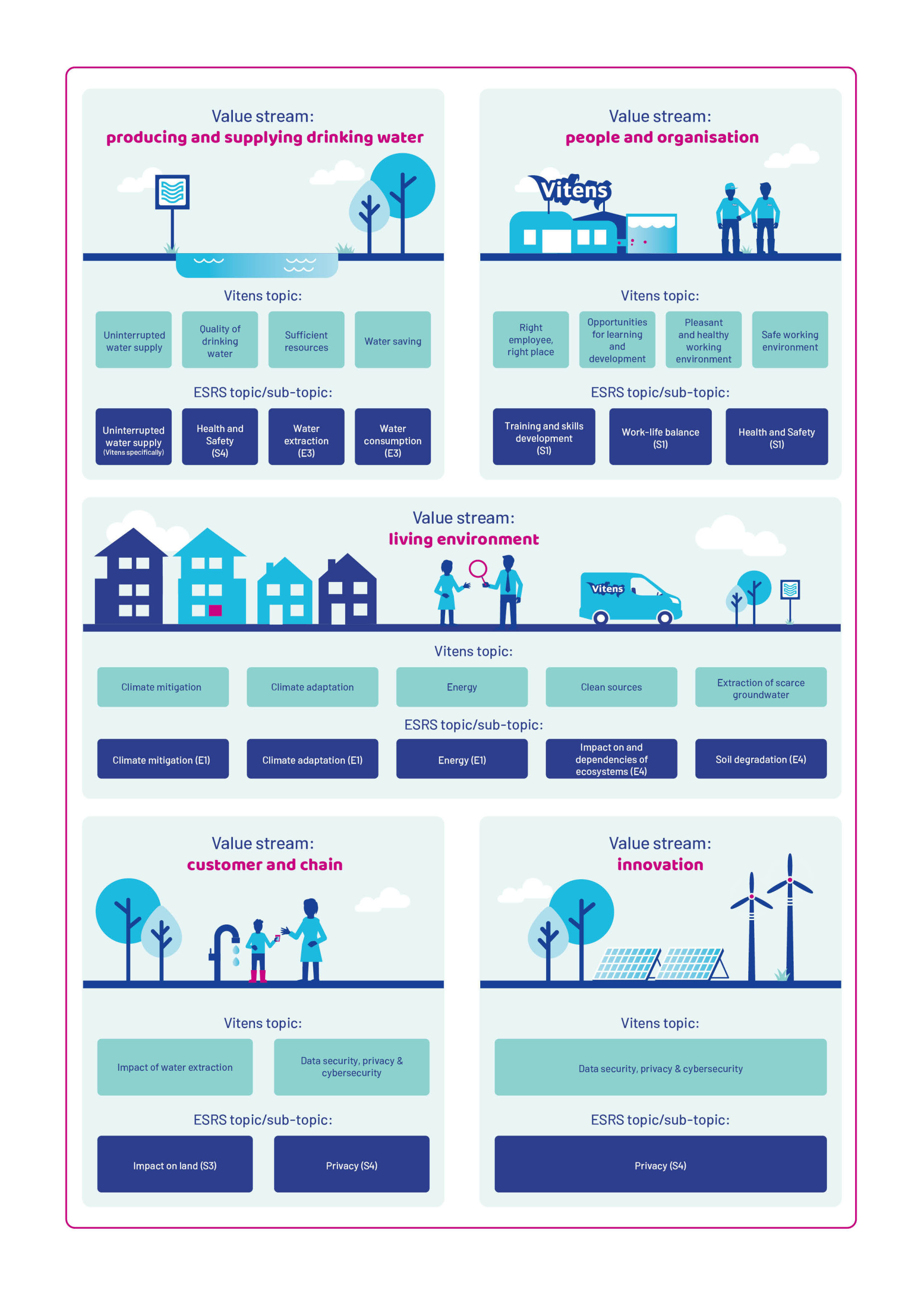
To help realise this future, we are committed to maximising the societal value we create through the drinking water supply in a variety of ways. We do this using so-called value streams:
Making and supplying drinking water
We ensure a sufficient supply of clean drinking water for all our customers, now and in the future. Through a resilient infrastructure, we contribute to a healthy living environment and a balanced water system that also benefits other land-use functions.
Customer and supply chain
We strive for co-creation and maintain strong relationships with our customers, suppliers, public authorities, communities, and other stakeholders, including agricultural and nature organisations. As part of our service provision, we distinguish between two customer groups within our service area: consumers and business customers.
People and Organisation
We are committed to the well-being (job satisfaction, safety) and flexibility of our colleagues. In addition, we foster a development-oriented culture in which we continue to learn, remain open to one another and support one another.
Living environment
We try to minimise the impact of our activities on the environment and surroundings; both within our own operations and across the wider value chain. We also aim for a net positive impact on biodiversity in the nature reserves we manage.
Innovation
We continuously improve our technologies and processes to produce and deliver drinking water more efficiently and sustainably. We actively share this knowledge and learn from each other.
Through this approach, we strive for a future in which everyone continues to have reliable access to sufficient clean drinking water. At the same time, this enables us—together with our stakeholders—to contribute more broadly to the wellbeing of people, the environment and society, and to a water system that is in balance.
To work towards this in a concrete way and bring this future vision to life, we have translated it into objectives and priorities for 2030.
The focus of our new strategy 2025 - 2030 is on:
Enhancing our ability to shape outcomes
There are limits to what is possible and feasible. At the same time, we can still take further steps to lay more pipelines or increase our drinking water production capacity. For example, this includes deepening our relationships with stakeholders to create synergies and accelerate progress, as well as securing external financing that enables us to increase our investment capacity.
Increasing resilience
To prepare our colleagues, assets, and customers and stakeholders for change, uncertainty, and ambiguity, we are strengthening our resilience. This includes building resilience into our assets, incorporating shock resistance into construction, reviewing the robustness of our supply chains and training our colleagues.
Improving our organisational strength
We are working towards an efficient organisation in which chains and systems operate seamlessly together, supported by professional operations, clear roles, engaged employees and strong leadership. In doing so, we focus on creating societal value, and we work safely — or we do not work at all. This is how we continue to contribute to societal value creation through our essential and remarkable product: drinking water, the source of life.
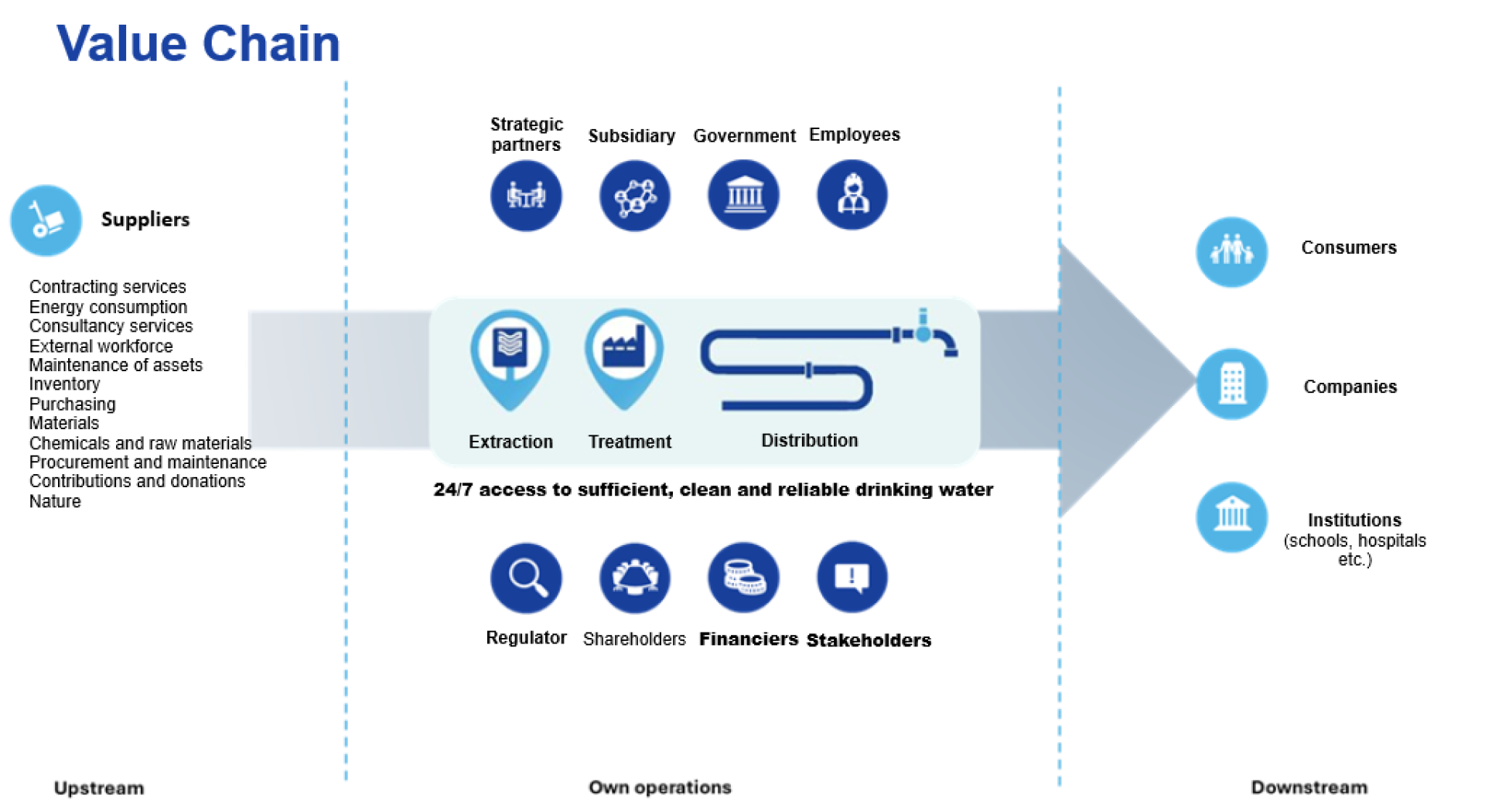
Value chain
The value chain in which Vitens operates has many stakeholders. Below is a visual representation of the inputs and outputs of the value chain. In addition, the representation highlights the key aspects of both the upstream and downstream value chain.
Stakeholder interests and perspectives
Stakeholder dialogue
Drinking water is the invisible force behind our society. The challenge we face to continue providing sufficient drinking water is immense. We cannot do that alone. We have a broad group of stakeholders, including employees, customers, public authorities, other drinking water and infrastructure companies, suppliers, shareholders, interest groups, educational and research institutions, and the media. Our challenge requires a collective effort from everyone across the water ecosystem. Each from their own role, but with a shared sense of urgency and reliability. Listening to our stakeholders and engaging in dialogue with them is therefore essential. This dialogue takes place continuously through various forms — such as customer satisfaction surveys, employee surveys, meetings with public authorities and sector partners, and consultations — but the method, frequency and timing depend on the specific stakeholder. By listening and maintaining an ongoing dialogue, we remain connected to our wider environment.
The outcomes of the stakeholder dialogue were incorporated into the double materiality assessment and were discussed periodically by both the Executive Board and the Supervisory Board.
Our stakeholders have not yet been involved in determining the policies for these themes, nor in the way this policy is made available. This also applies to the way we formulate our objectives. Furthermore, these objectives are not yet based on convincing scientific evidence. In 2026, where possible, we aim to further develop and address these points.
In 2025, discussions with stakeholders did not directly lead to adjustments to Vitens' strategy or business model. Stakeholders do, however, indicate that they would benefit from a more realistic message, as our plans are often presented too optimistically. We also observed that a large-scale boil-water advisory in 2025 had a significant impact on our customers, yet this impact did not explicitly emerge from our current double materiality assessment (see the section ‘Description of the processes for identifying and analysing material impacts, risks and opportunities’). We will include both points in the next review of the DMA.
Material impacts, risks and opportunities and their interaction with strategy and business model
When implementing the CSRD guideline, as laid down in the ESRSs, Vitens started with a double materiality analysis to arrive at material topics. In the double materiality analysis, we looked both inside‑out
(the positive and negative impacts we have on people and the environment) and outside-in
(external sustainability‑related developments that have an impact on Vitens). Regular conversations with internal and external stakeholders arising from our day-to-day operations, together with in-depth interviews and a survey, supported the strategic review by helping us sharpen our focus and define priorities. By better understanding our impact (both positive and negative), risks and opportunities, we are better able to steer Vitens' societal value creation. It helps us in making choices and prioritising. This enables us to increase our positive long-term impact and gain a clearer understanding of our negative impact, allowing us to reduce it in a more targeted way. To enable effective steering, several material topics have been consolidated and aligned with the previously mentioned strategic themes.
The overview below shows how the strategic themes derived from our value streams are linked to the ESRS themes.
Description of processes to identify and analyse material impacts, risks and opportunities
Vitens has established a process to identify material impacts, risks, and opportunities. This process was already in place at the start of the financial year and served as input for sustainability reports that were prepared and published in previous years. Impacts, risks and opportunities form an important element in determining the topics to be reported in the sustainability disclosures. As part of the double materiality assessment, this process formed the basis for determining which disclosure requirements from the ESRS standards are included in this sustainability statement.
Our double materiality assessment (DMA) process consists of five steps. We first map out the business context and key stakeholders. We then identify impacts, risks and opportunities arising from sustainability issues. We then score the topics and determine which ones are material. The final step is to validate the outcomes from the double materiality analysis (DMA).
Step 1: mapping the business context
An important first step in the DMA is gaining a clear understanding of the business context. This also involves understanding Vitens' place in the value chain. Vitens has updated its existing sustainability analysis, based on the GRI, and adapted it to the ESRS guidelines. This included examining the role of Vitens as a drinking water company, its societal responsibilities, the value chain in which Vitens operates, and the broader ESG landscape. The analysis was based on the ESRS structure (topics, sub-topics and sub-sub-topics) to ensure that all relevant sustainability topics were included.
Step 2: Identifying and engaging key stakeholders
Internal and external stakeholders were involved in the DMA process through a comprehensive questionnaire and in-depth interviews. Stakeholder input was used to assess the relevance of the topics and to determine perceptions of both societal and financial impact. The stakeholder input was then interpreted and refined by internal specialists. The stakeholders involved are listed in section 3.1.3, under the subsection ‘Stakeholder interests and perspectives'.
Step 3: identify impacts, risks and opportunities
A longlist of 15 sustainability themes was started, based on previous GRI analyses. These topics were assessed against all ninety ESRS sub‑and sub-sub‑topics, as the GRI themes were considered too broad. This in-depth analysis was carried out by Strategy and Concern control, with the Vitens (broad) themes being divided into sub-themes. Each sub-theme is linked to specific ESRS sub-topics and sub-sub-topics. This breakdown improves the usability and quality of the reporting and prevents broad themes from becoming overly expansive. This provides a more focused understanding of where impacts, risks and opportunities occur throughout Vitens' value chain. We also looked at possible 'white (blind) spots' in the analysis. This was done in part by comparing the relevant topics across the different drinking water companies within the sector association (Vewin).
The longlist was then used as the basis for step 4. We chose to exclude topics that do not qualify as ESG topics, such as financial health, from further analysis.
Step 4: scoring the topics and determining the material topics
A sustainability topic is considered material when it relates to the company’s material actual or potential, positive or negative impacts on people or the environment, and/or when associated risks or opportunities are material. This could be short, medium and long-term. For each topic on the longlist, the impacts, risks, and opportunities (IROs) were identified and assessed, qualitatively refined and evaluated to determine where in the value chain the impact occurs. The elaboration is aligned with ESRS requirements and provides a crucial basis for assessing materiality. For each topic, a score was then assigned based on:
- Impact materiality: scale, scope and irreversibility.
- Financial materiality: financial significance and likelihood.
The strategy team then calculated a score for each dimension. These scores are based on stakeholder input, the underlying documents described in Step 5, and the professional judgement of our strategists. Each dimension was scored on a scale from 1 (low) to 3 (high). The scores were aggregated. Each topic therefore received a score ranging from a minimum of 3 to a maximum of 9 points for impact materiality, and from a minimum of 1 to a maximum of 6 points for financial materiality.
The threshold for impact materiality is >6 (greater than 6) and the threshold for financial materiality is >4 (greater than 4). The results for each topic were then used to determine which topics exceeded the threshold value and were therefore considered material. The threshold values were determined by strategists and coordinated with internal experts. In determining the threshold value, an assessment was made of the point at which a topic is considered material. This point is reached when a topic has scored more than two-thirds of the available points. A score above this threshold for either impact materiality or financial materiality therefore results in the topic being classified as material. This ensures focus and practicality in the reporting process.
Step 5: validation of the double materiality assessment
The results of the analysis were validated by comparing them with the preliminary materiality outcomes of the other Dutch drinking water companies. This peer review confirmed the relevance of the selected topics. In addition, the double materiality analysis (DMA) was adopted by the Executive Board (BoD) and validated by the Supervisory Board (SB).
By 2025, the strategy process was formalised and established. The double materiality analysis has taken on an important role within this process. The process ensures that the DMA is reviewed annually (for updates) and comprehensively reassessed every three years. The outcomes of the DMA are fed into the strategic advice and scenarios submitted to the Executive Board.
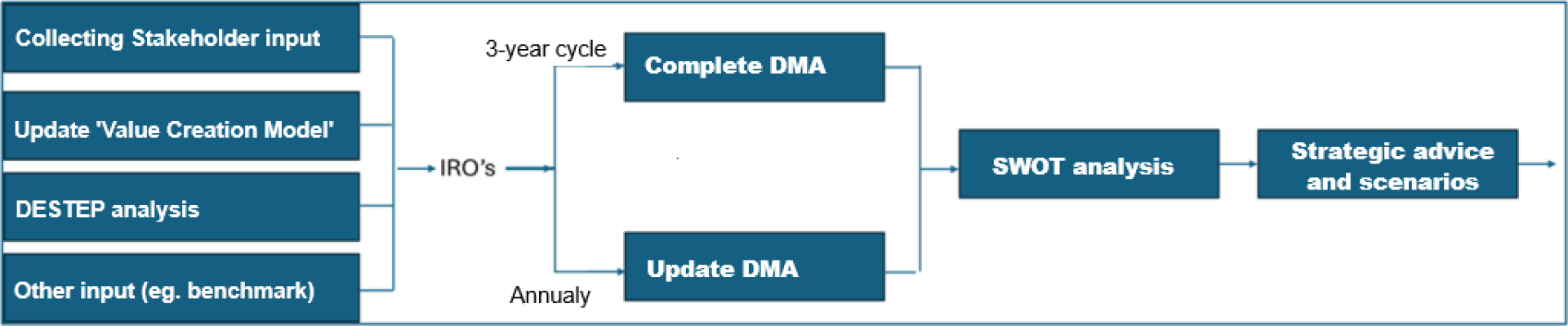
The basis for the double materiality analysis (DMA) is formed by a wide range of information flows. These include:
- A DESTEP analysis (a signalling report that looks at external developments in terms of Demography, Economy, Social, Technical, Ecological, Political-Legal) with potential impact on Vitens;
- The employee satisfaction survey;
- Reflections from stakeholders through the stakeholder survey;
- Dialogue through our environmental managers and strategic environmental managers and benchmarks in which Vitens participates.
The table below presents the ESRS topics together with the defined impacts, risks and opportunities that emerged as material themes from our double materiality assessment.In this table, KT stands for short-term, MT for medium-term and LT for long-term.
| ESRS topic/sub-topic | Material impact, risk, opportunity | Scope | Time horizons |
|---|---|---|---|
| E1 Climate mitigation, energy | Impact (negative): | ||
| • Emissions and energy use contribute to climate change | Our own activities, downstream | KT, MT, LT | |
| E1 Climate adaptation | Risks: | ||
| • Sites may have to be closed/moved due to drought | Our own activities | LT | |
| • Actions may need to be taken to make sites climate adaptive (flooding, drought, forest fires) | Our own activities | MT, LT | |
| • Possibly more frequent damage to assets due to weather extremes | Our own activities | KT, MT, LT | |
| E3 Water extraction | Impact (negative): | ||
| • Vitens uses scarce groundwater as its main source of drinking water production. | Entire chain | KT, MT, LT | |
| Risks: | |||
| • Developing new sites leads to higher costs and permit pressure | Our own activities | LT | |
| • New extractions and alternative sources may be needed: more complex treatment leads to higher costs and permit pressure | Our own activities | LT | |
| Opportunity: | |||
| • Source diversification, despite higher costs, makes Vitens less vulnerable to external influences and thus reduces the risk of outages and disruption of water supply. | Entire chain | LT | |
| E3 Water conservation | Impact (positive): | ||
| • Water conservation among customers dampens peak demand and reduces the risk of water scarcity. | Downstream | KT | |
| E4 Land degradation | Impact (negative): | ||
| • Groundwater extraction may lead to a groundwater level drop in the vicinity of the extractions or have a potentially negative impact on groundwater-dependent nature locally. Healthy nature is important because of the purifying effect of healthy soil. | Entire chain | KT, MT, LT | |
| Risk: | |||
| • Sites may have to be closed/relocated to spare nature and/or Vitens may have to purify more because there is more pollution in the water. | Our own activities | LT | |
| E4 Impacts on and dependencies of ecosystems | Impact (positive): | ||
| • By managing water catchment areas and exploiting the purifying properties of the soil, Vitens contributes to the preservation of clean drinking water sources and clean soil. This has a positive impact on drinking water quality and the ecosystem. | Our own activities | KT, MT, LT | |
| Risk: | |||
| • Soil contamination and ageing of groundwater can lead to additional groundwater treatment steps. | Our own activities | MT, LT | |
| • If groundwater sources become contaminated, it could limit the availability of drinking water. | Entire chain | KT, MT. LT | |
| S1 Health and Safety | Impact (positive): | ||
| • A safe and pleasant working environment contributes to employee well-being, health and sustainable employability. | Our own activities | KT, MT, LT | |
| Risk: | |||
| • If the workplace is perceived as not nice or safe then the risk of absenteeism and staff turnover increases. The effort to absorb/fill these positions is becoming increasingly costly in a strained labour market. | Our own activities | KT, MT, LT | |
| • If safety is not in order then the risk of accidents and incidents increases resulting in injury, damage to image and disruptions. | Our own activities | KT, MT, LT | |
| S1 Work-life balance | Impact (positive): | ||
| • Vitens wants to be an attractive employer by ensuring a good work-life balance for its employees. | Our own activities | KT, MT, LT | |
| Risk: | |||
| • The strained labour market carries the risk of not being able to find the right person. Low staffing may result in current employees having to perform more tasks or employees who lack the right qualities having to do work that is too challenging in terms of quality. Both impacts negatively affect employees' work-life balance. | Our own activities | KT, MT, LT | |
| S1 Training and skills development | Impact (positive): | ||
| • Vitens invests in the training and development of its employees. As a result, employees are well equipped for their assigned tasks. | Our own activities | KT, MT, LT | |
| Opportunity: | |||
| • Investing in training and development opportunities contribute to employees' employability and agility. | Our own activities | KT, MT, LT | |
| S3 Impact on land | Impact (negative): | ||
| • Besides impacting nature, groundwater extraction in some areas also impacts agriculture resulting in drought damage. | Downstream | KT, MT, LT | |
| Risk: | |||
| • Compensation for drought damage may have to be effected differently in the future. For example, due to changed insights or measurement methods by the ACSG. | Downstream | MT. LT | |
| S4 Ensuring uninterrupted water supply at Vitens | Impact (negative): | ||
| • Disruptions in drinking water supply directly affect both consumers and business customers. In the event of prolonged disruptions, this can have disruptive consequences for society. | Downstream | KT, MT, LT | |
| Risk: | |||
| Technical manufacturing feasibility is under pressure, and this poses a number of risks to security of supply: | |||
| • There is an imminent shortage of people and resources to maintain existing assets. | Downstream | KT | |
| • The international supply chain is vulnerable, resulting in a shortage of materials, which are required for the purification process (e.g. chemicals). Delivery times and prices are also increasing. | Downstream | KT | |
| • Specific knowledge of the assets and the system possessed by more experienced staff may be lost as people leave the company or retire. As a result, it takes longer to resolve disruptions. | Downstream | KT | |
| • Grid congestion is becoming an increasing problem for Vitens. Due to grid congestion, there is uncertainty about connecting consumers to Vitens' water supply. This could jeopardise uninterrupted water supply. | Downstream | KT | |
| • Maintaining resilient infrastructure requires significant investment. One potential risk is that, due to the current WACC regulations, Vitens may not be able to finance these investments. | Downstream | KT, MT, LT | |
| S4 Health and safety | Impact (positive): | ||
| • The public health value of a reliable supply of drinking water is high and contributes to customer welfare and a positive business climate. | Downstream | KT, MT, LT | |
| Risks: | |||
| • A shortage of people and resources to maintain existing assets. | Downstream | KT | |
| • The international supply chain is vulnerable, leading to a shortage of materials needed for the purification process and causing delivery times and prices to rise. | Downstream | KT | |
| • Specific knowledge of the assets and the system possessed by more experienced staff may be lost as people leave the company or retire. As a result, it takes longer to resolve disruptions. | Downstream | KT | |
| • Maintaining resilient infrastructure requires significant investment. One potential risk is that, due to the current WACC regulations, Vitens may not be able to finance these investments. This could have a negative impact on the safety and health of Vitens' drinking water. | Downstream | KT, MT, LT | |
| • Grid congestion is also becoming an increasing problem for Vitens. Locally, addition of additional treatment steps is required due to deterioration of groundwater quality. Due to grid congestion, Vitens’ energy requirements for carrying out these additional treatment stages are at risk. | Downstream | KT | |
| Opportunity: | |||
| • The introduction of new purification techniques and measuring instruments offers opportunities for improved reliability and efficiency, and makes it possible to keep certain sites in operation for longer and in a more sustainable manner. | Downstream | MT, LT | |
| S4 Privacy | Impact (negative): | ||
| • Vitens holds a broad set of customer data, some of which involves sensitive information. Incidents involving this data have a negative impact on customers’ privacy. | Our own activities and downstream | KT, MT, LT | |
| • Drinking water supply is a critical infrastructure. Disruption and interruption due to cyber incidents can have disruptive consequences. | Our own activities and downstream | KT, MT, LT |
These topics form the core of Vitens' sustainability statement and shape the organisation’s strategic direction and sustainability objectives.
Reporting requirements in ESRS included in company's sustainability statement
Section 3.5 provides a reference table of explanatory requirements. In this section we report on the ESRS disclosure requirements, including references to where the relevant information can be found in the report and which phase-in options have been applied.